
If you want a home that looks cared for without a renovation, interior decoration tips mintpaldecor can help you change one room at a time, starting with the rooms you use most. This guide gives you a room-by-room weekend plan with clear steps, realistic quantities and the mistakes to skip.
Key Takeaways
- Start with the room you use most, finish it completely, and only then move on, so the work never spreads into half-finished chaos.
- Move furniture, lamps and art you already own before buying anything new, because a better layout often fixes a dull room.
- Plan paint by the wall, not the room, and measure each wall before you buy so you do not run out mid-way through the second coat.
- Give every room one clear focal point, such as the sofa wall or the bed wall, and keep everything else quieter around it.
- Small, cheap changes such as matching frames, a right-sized rug and working bulbs change a room more than one expensive piece.
Where should you start with interior decoration tips mintpaldecor in your own home?
Start with the living room if your family gathers there, or the bedroom if poor sleep is your biggest complaint, and leave the hallway and spare rooms until later. A finished room you use every day rewards you every evening. Walk through your home with a notebook and write down, for each room, the one thing that bothers you most when you enter it, then pick the room with the most annoying problem.
Before you buy anything, spend one hour on the free steps: open every curtain fully, clean the windows inside, and replace any dead bulbs. Then take everything off the surfaces in the chosen room and sort it into three piles: keep in this room, move to another room, and remove from the house. Work in this order: layout first, then light, then colour, then texture, then small decoration. A framed print cannot rescue a sofa that blocks the walkway.
How can interior decoration tips mintpaldecor refresh a living room in one weekend?
Begin on Saturday morning by pulling every piece of furniture at least 10 centimetres away from the wall, even in a small room. A sofa pushed hard against the wall makes a room look like a waiting area, while a small gap behind it lets a floor lamp or a tall plant sit there. Arrange the seating so two people can talk without raising their voices, with chair and sofa ends roughly 1.5 to 2.5 metres apart, and leave a walking path at least 75 centimetres wide between the seating and the television.
Once the layout is set, fix the light and the rug. Use three layers — ceiling light, a lamp beside the main seat, and one low lamp — with warm white bulbs around 2700K as a practical estimate. Choose a rug that sits under the front legs of the sofa and chairs, with at least 15 centimetres visible beyond each front leg.
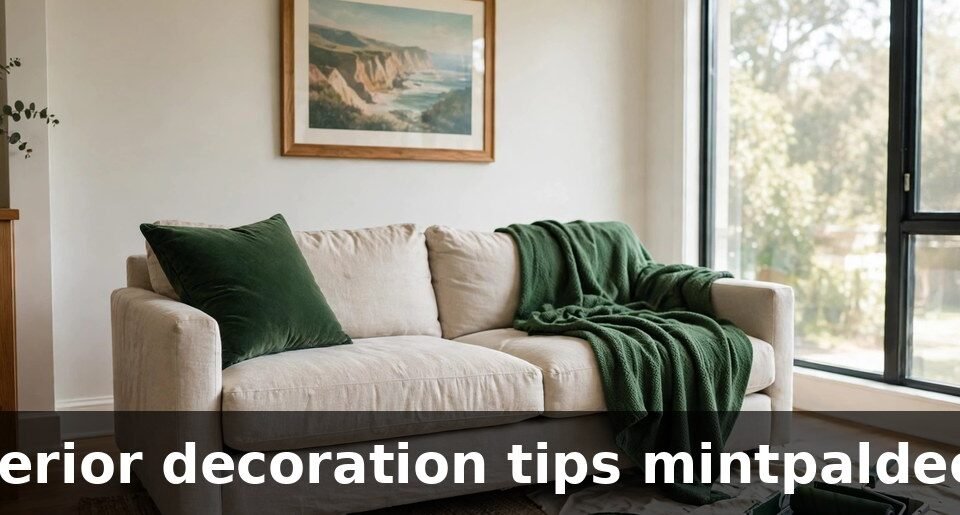
Finish with one colour and one wall. Add one colour in three places — a deep green cushion, a green throw over the sofa arm, and a green plant pot — and keep the rest neutral. Hang one large framed picture at eye level, its centre roughly 145 to 150 centimetres from the floor. If you repaint one wall, a standard wall of about 3 by 2.5 metres needs roughly 2 litres for one coat as a practical estimate, and two coats are normal. Use a Paint Calculator before you buy so you order the right amount, and buy the second tin at the same time so the batch colour matches.
What makes a bedroom feel calmer with interior decoration tips mintpaldecor?
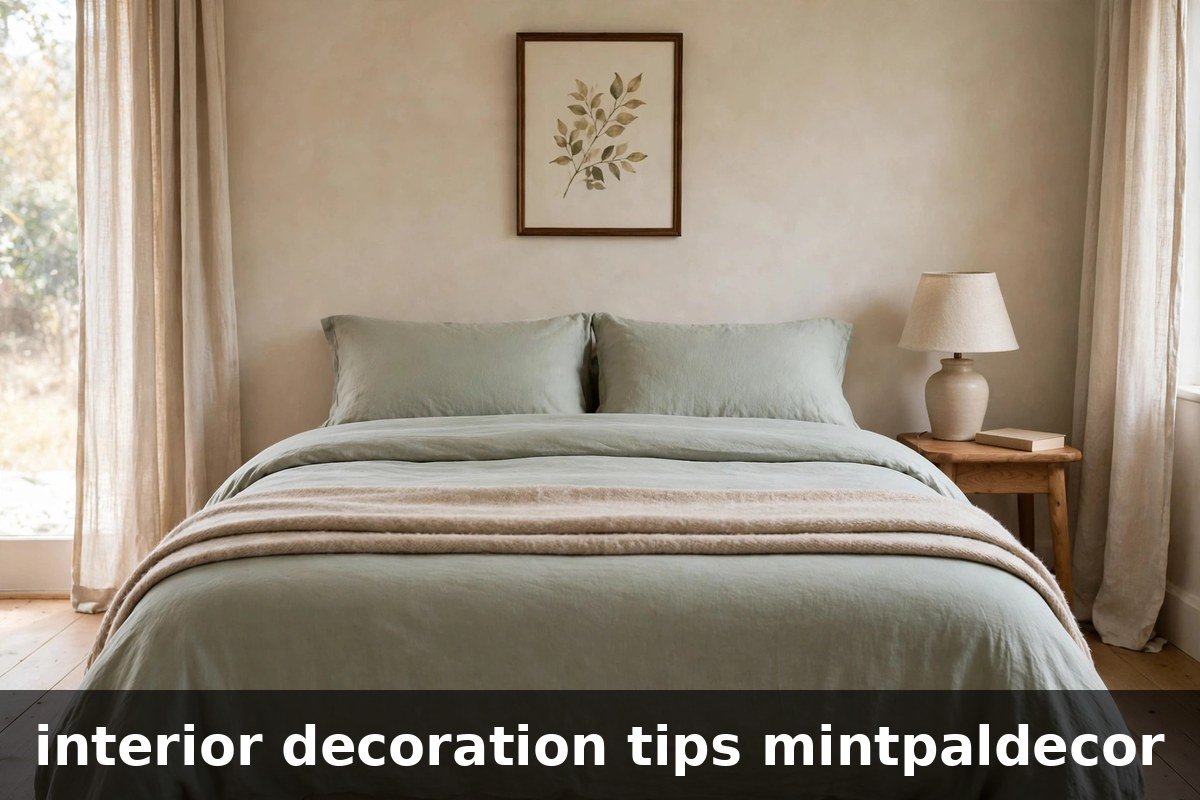
Start a calm bedroom at the bed wall, because that is the wall facing you when you wake up and the last one you see before the lights go out. Centre the bed on the longest clear wall if you can, and leave at least 60 centimetres of clear space on the side you get out of. Put one picture or a single shelf above the bed and line it up with the bed itself, not with the middle of the wall.
Bedding matters more than most decoration, because it covers the largest surface in the room. Keep the duvet cover one plain colour and let pattern in only through the pillowcases or a throw folded across the foot of the bed. As a practical estimate, a throw about 130 by 170 centimetres fits a double bed without dragging on the floor. Keep the bedside table to five items at most — lamp, book, glass of water, phone charger and one small personal object — and add a blackout lining behind the curtains if street light leaks in at night.
Finally, give worn clothes a home — a hook rail or lidded basket near the wardrobe, emptied every three days — so the bed and floor stay clear.
How do you decorate a kitchen and bathroom when you cannot change the fixtures?
Where the fixtures must stay, decoration works on the surfaces you are allowed to change: walls, textiles, storage and light. Start in the kitchen by clearing the counters completely, then putting back only the five things you use every day, such as the kettle, the chopping board, the oil bottle, the knife block and the fruit bowl. Everything else goes into a cupboard, because a counter with twelve objects looks busy and a counter with five looks intentional. Group the five survivors on one side of the sink or the hob, leaving the main preparation area empty.
Colour in a kitchen comes from textiles, not from the units. A washable runner in front of the sink, matching tea towels and a single plant on the windowsill change the room for very little money, and all three can move with you if you rent. Avoid sticking patterned film or tiles over a landlord’s surfaces without written permission, because removing it later can damage the finish. Bathrooms follow the same rule: replace the shower curtain, bath mat and hand towels as a set in one colour, and put everything except your four or five daily products into a closed box under the sink.
In the bathroom, check the mirror light: if the only bulb is a ceiling light behind you, your face will be in shadow every morning. A stick-on light bar above the mirror fixes this without wiring work, but never fit a mains-powered fitting near water yourself — that is a job for a qualified electrician. Finish by matching the soap dispenser, toothbrush holder and hand towel in one colour family.
How much paint, time and money should you plan for each room?
Most weekend decorating fails on planning, not on taste. Before you start, measure each wall you intend to paint: a wall 3 metres wide and 2.5 metres high is 7.5 square metres, and a room with four such walls is 30 square metres before you subtract doors and windows. Paint coverage varies by brand and surface, so treat the figures in the table below as practical estimates, not a guarantee, and always check the tin you buy. Buy the paint for the whole job in one trip and keep the batch number.
Time works the same way: drying time, not painting time, decides the schedule. As a practical estimate, allow one hour to move furniture and tape edges, one hour per coat, and at least four hours of drying between coats, with overnight drying before furniture goes back against a fresh wall. That is why a one-room weekend works and a three-room weekend usually does not.
Money follows the same discipline. Set the budget per room before you shop, and split it roughly into thirds: paint and tools, the largest soft item such as a rug or curtains, and everything small. If the rug you want costs the whole budget, buy the paint and the rug and skip the small items until next month. The tables below give you planning figures to start from.
| Room | First job to do | Time as a practical estimate | Cost as a practical estimate |
|---|---|---|---|
| Living room | Move furniture, set the rug, hang one picture | One full day | Medium — rug is the big cost |
| Bedroom | Centre the bed, fix bedding, sort bedside tables | Half a day | Low — bedding and lamp |
| Kitchen | Clear counters, add textiles, sort storage | Half a day | Low — textiles and hooks |
| Bathroom | Match textiles, add closed storage, fix mirror light | Two to three hours | Low — textiles and holders |
| Entryway | Clear the floor, add hooks and one mirror | Two to three hours | Low — hooks, mirror, mat |
| Wall area to paint | Paint needed as a practical estimate | Coats | Notes |
|---|---|---|---|
| One feature wall, about 7.5 sq m | About 2 litres | 2 | Buy both tins together for matching colour |
| Small room, about 25 sq m | About 5 litres | 2 | Subtract doors and windows first |
| Average room, about 35 sq m | About 7 litres | 2 | Rough or new plaster needs more |
| Large room, about 50 sq m | About 10 litres | 2 | Plan two days, not one |
What should you fix first in an entryway so the whole home feels pulled together?
The entryway may be the smallest space in the house, yet it shapes how the whole home feels the moment you step inside — which is why it so often gets decorated last. Start by clearing the floor completely: give shoes, bags and parcels a place — one low shoe rack or lidded bench, one row of hooks at adult height and one lower row for children, and one basket for things leaving tomorrow. If the floor is clear when you open the door, the home already feels larger.
Add one mirror above the console or bench so the average adult sees their face without bending, and keep one small tray below it for keys — keys only, or the tray becomes a junk drawer again. A doormat that fits the width of the door finishes the space and catches dirt before it reaches the living room.
Light matters most in a hallway because hallways rarely have windows. If the ceiling light is a single bare bulb, fit a simple shade that spreads the light sideways rather than straight down. As a practical estimate, a warm bulb around 2700K keeps a hallway welcoming, while a cool white bulb makes white walls look like an office corridor. One framed picture at the end of the hallway pulls the eye forward. If you are still deciding whether interior design is worth the effort, reading about why interior design is interesting mintpaldecor is a useful place to start.
What these tips cannot do
These tips cannot fix a damp wall, a leaking roof, a broken window seal or a floor that slopes. If a wall shows dark patches that return after cleaning, a musty smell that does not clear with ventilation, or paint that bubbles within weeks, the cause is water, not decoration. Call a builder or a damp specialist first, and decorate only after the cause is fixed and the wall is fully dry, which can take several weeks. A crack wider than about 5 millimetres, a crack running diagonally, or a door that suddenly sticks should be checked by a professional first.
These tips also cannot make a very small room large: a bedroom that fits a double bed and one wardrobe will not become a suite by adding mirrors. Structural change, such as removing a wall, is a building project with permits and a professional, not a weekend job. Finally, if anyone in the home uses a wheelchair, has poor eyesight or is unsteady on their feet, clear floor space and grab rails matter far more than picture height, and anything involving electricity, gas, water or load-bearing walls belongs to a qualified professional.
Frequently asked questions
How long does it take to decorate one room with interior decoration tips mintpaldecor?
As a practical estimate, one room takes one full weekend day from clearing the surfaces to putting the furniture back, plus overnight drying if you paint. The living room usually needs a full Saturday, a bedroom needs half a day, and a bathroom needs two to three hours.
What is the cheapest way to make a room look decorated?
Move the furniture into a better layout, clean the windows, replace dead bulbs and remove everything that does not belong in the room, all of which cost nothing. After that, the cheapest purchase with the biggest effect is usually matching textiles, such as a plain duvet cover, matching towels or a single rug in the right size.
How big should the rug in my living room be?
Start by measuring the sofa and chairs as one group, instead of measuring the room itself. Pick a rug large enough to tuck under the front feet of every seat, leaving a visible border of at least 15 centimetres past each one. If you cannot afford the right size, a smaller rug looks better centred under the coffee table than half under the sofa.
Can I decorate a rented home without losing my deposit?
Yes, if you change only what is removable: textiles, freestanding furniture, plants, hooks that use adhesive strips rated for the wall, and battery lights. Do not paint, drill, stick film to tiles or change light fittings without written permission from the landlord.
What is the biggest mistake people make when decorating room by room?
The biggest mistake is buying decoration before fixing the layout and the light. Cushions, frames and ornaments cannot fix a sofa that blocks the door, a room with one dead bulb, or a rug that is too small. Fix the layout first, then the light, then the colour, and buy the small decoration last.
Conclusion
interior decoration tips mintpaldecor work best as a weekend routine rather than a single shopping trip, because one finished room teaches you more than a dozen ideas left half done. Start with the room you use most, follow the order of layout, light, colour, texture and small decoration, and let each room stay finished before you begin the next one. For more home improvement advice you can measure, visit Mintpaldecor.



1 comments