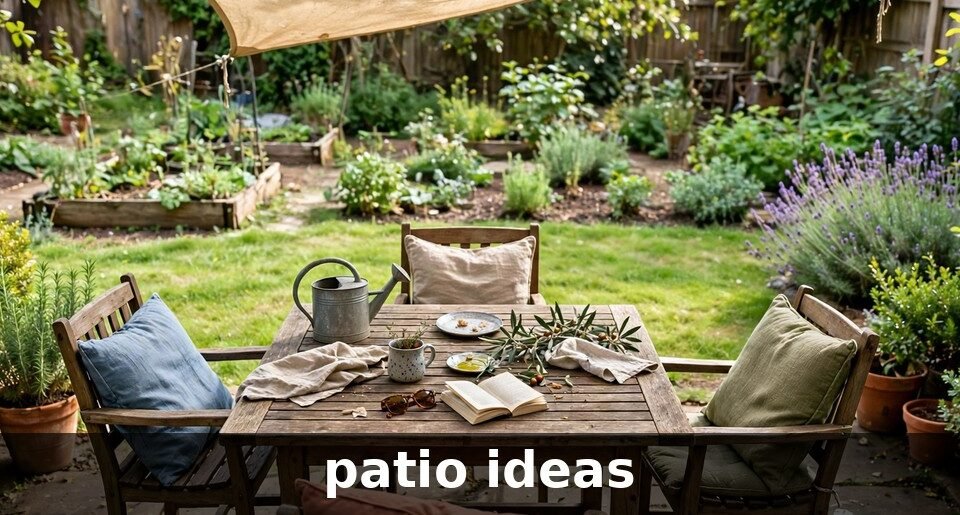
Good patio ideas turn a paved slab into a comfortable outdoor room for eating, resting and long evenings outside. The best patio ideas start with the surface and the layout, then add furniture, shade and planting in that order, so the space works every day, not only on sunny weekends.
Key Takeaways
- Start with the surface and the layout before buying furniture or plants.
- Measure the patio and mark out furniture zones on the ground before ordering anything.
- One comfortable seating zone, used daily, beats a patio crowded with pieces.
- Shade, lighting and a clear route to the door matter more than decoration.
- Plant at the edges and phase the work so the patio stays usable while it improves.
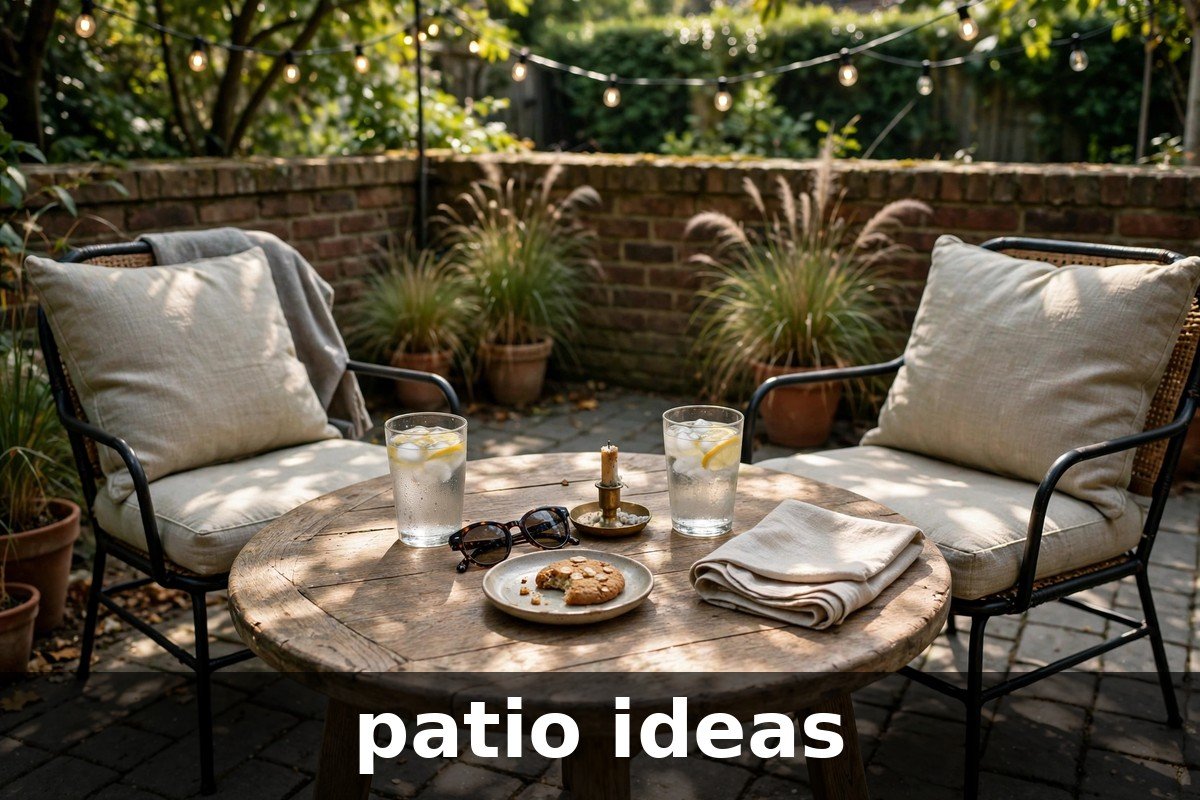
What makes a patio feel like an outdoor room?
A patio feels like an outdoor room when it has a clear purpose, a defined edge and a reason to step outside. Most patios fail on the first point: a paved slab, a table and some chairs, but no obvious place to sit comfortably, no shelter from the sun and no planting to soften the hard edges. The result is a patio looked at through the window far more often than it gets used.
Treat the patio like a room inside the house. A living room has a place to sit, a surface for a drink, light you can adjust and something pleasant to look at. A patio needs the same four things outdoors: seating first, then a table within reach, then shade you can control, then planting that makes the space feel finished. Boundaries help too: a low wall, planters or a change in paving can mark where the patio ends and the garden begins, which makes the space feel intentional rather than leftover.
Scale matters as well. Oversized furniture on a small patio leaves no room to walk, while a tiny table on a large patio looks lost. Measure the patio before buying anything, and mark out the furniture positions with chalk or tape on the paving so the layout can be tested before money is spent. Patio ideas work best when the space is planned as a room with a job to do, not as a decorative slab.
How do you choose a patio surface?
The surface is the biggest decision on a patio, because it is the most expensive to change later and it sets the look of the whole space. The main choices are pavers, natural stone, concrete, decking boards and gravel, and each suits a different kind of patio. Pavers are the most common choice for a family patio: many colours and sizes, liftable and relayable if one cracks, and they suit a level surface. Natural stone costs more and needs a solid base, but it ages well and suits older houses. Concrete is the cheapest hard surface and can be tinted or textured, though a plain slab can look flat without planting or furniture. Decking boards give a warm surface underfoot and suit a raised or uneven site, but they need regular cleaning to stay safe underfoot. Gravel is cheap and quick to lay, but it moves underfoot, needs edging and does not suit dining chairs.
Drainage decides whether a surface stays pleasant. A patio that holds puddles after rain is a patio nobody uses, so the surface should slope gently away from the house — as a practical estimate, a fall of about 2 centimetres over a metre of paving moves water without being noticeable underfoot. The base matters just as much: pavers and stone need a compacted base of hardcore and sand, or they will sink and rock within a season or two.
Quantities are worth working out before ordering, because pavers, stone and gravel are sold by area or volume and are awkward to return. Measure the patio, decide on the paver size and joint width, and work out the number first. A Paver Calculator can do the arithmetic once the measurements are known, so the order matches the patio rather than a guess. Order a few spare pavers, because matching the exact colour later is rarely possible.
| Patio surface | Best for | Practical drawback |
|---|---|---|
| Pavers | Family patios, most house styles | Joints need weeding and re-sanding over time |
| Natural stone | Older houses, a timeless look | Higher cost and needs a solid, level base |
| Concrete | A tight budget, a large level area | Can look flat without planting or furniture |
| Decking boards | A raised or uneven site, warm feel | Needs regular cleaning and care |
| Gravel | A quick, cheap surface, informal corners | Moves underfoot and does not suit dining chairs |
How should you lay out furniture zones on a patio?
Furniture zones decide whether a patio gets used or just looked at. The simplest approach is to divide the patio into two or three zones by use: one for eating, one for sitting, and, if there is room, one quiet chair with a book. Each zone needs its own reason to exist, or it will collect clutter instead of people. A dining zone needs a table with chairs that pull out, a sitting zone needs deep chairs with a small table for drinks, and a quiet corner needs one comfortable chair and a little shade.
Indoor design thinking helps here too: the same ideas behind interior design tips mintpaldecor — measure the space, leave clear walking routes, group furniture by how it is used — apply directly to a patio. Leave a clear route from the back door to the garden, wide enough for two people, and keep it free of pots and furniture. A dining table needs room around it: as a practical estimate, allow about 75 centimetres behind each chair so people can sit down and stand up without pushing the chair into a wall or a bed.
Shade decides when the zones get used: a patio in full sun is pleasant for about an hour in the morning, then too hot for most of the day. An umbrella is cheap and movable but covers a small area. A pergola gives structure and can carry climbing plants, but it costs more. A shade sail covers a large area cheaply, though it needs strong fixing points. Position matters too: watch where the sun falls in the late afternoon, when most families use the patio, and seat people in the shade then.
How do you light a patio for evenings?
Evening light is what turns a patio from a daytime space into a place used after dinner. The mistake is to light it like a room, with one bright light that flattens everything. A patio needs layers: a little light for the table, a little for the path, and a little for the planting, so the space feels deep rather than exposed. Warm light suits a patio better than cold white light, because it feels closer to candlelight.
Start with the table: a low lantern, a string of festoon lights overhead or a small solar lamp gives enough light to eat by without glaring. Festoon lights are the easiest win: one string across the seating zone, hung from a wall, a pergola or a tall post, changes the whole evening at little cost. Keep them warm white and dim, so faces are lit softly.
Add light for the route next. The path from the back door to the patio needs to be visible after dark, or nobody will use it: small solar spike lights along the path edge, or low wall lights by the door, are enough. Avoid pointing a bright security light at the seating area, because it kills the mood instantly. A single uplight in a bed gives the patio depth without lighting the whole garden; solar lights need direct sun during the day to charge.
What planting works at the edges of a patio?
Planting is what stops a patio feeling like a car park. The edges are the right place for it: beds along the walls, planters at the corners, and climbers on a fence or pergola. The middle of the patio should stay clear for furniture and movement, because a pot in the walking route gets kicked over within a week.
Choose structure first and colour second. Planting is decoration, and the rule from house decoration advice mintpaldecor applies here too: choose the big structural pieces first and add colour last. One or two evergreen shrubs in large pots give the patio shape through winter. Grasses suit patio edges well, because they move in the wind and need little water once established. Climbers on a pergola or fence give shade and privacy without taking up floor space, though they need strong support and yearly tying-in.
Pots need more care than beds, because they dry out fast in sun and wind. Bigger pots are simpler to keep alive — a large pot carries a lot more soil, so it stays damp for days rather than hours. As a practical estimate, a pot narrower than about 40 centimetres dries out within a day or two in hot weather, so water daily in summer or choose drought-tolerant planting. Group pots in threes of different heights rather than lining them up in a row. Herbs by the back door earn their place twice over: they are useful in the kitchen and smell good when brushed past.
| Planting at the patio edge | Where it works | Upkeep it still needs |
|---|---|---|
| Evergreen shrubs in large pots | Corners and by the door, year-round shape | Watering in dry spells, a yearly trim |
| Ornamental grasses | Along the sunny edge, soft movement | Cutting back once a year in late winter |
| Climbers on a pergola or fence | Shade and privacy without floor space | Tying in new growth and yearly pruning |
| Herbs by the back door | Small pots near the kitchen, scent and use | Regular watering and picking to stay bushy |
| Low ground cover in beds | Softening the hard edge of the paving | Weeding while young, a mulch top-up yearly |
What can patio ideas not fix?
A new patio improves a garden a lot, but there are problems paving alone will not solve — and spending on the patio first is the quickest way to waste money on them. First is sloping ground. When the ground falls hard toward the house, rain runs downhill whatever the surface is, so the answer is groundwork — a terrace, a retaining wall or a drain put in properly — before any paving goes down.
A patio also will not rescue a garden that is run down in other places. Fresh paving next to a leaning fence or weedy beds only makes the tired parts stand out more. Sort the boundaries and the beds out first, then lay the patio to show the result off. One swept slab with a single planted bed beside it beats a brand-new patio in front of a fence that is falling over.
Privacy is another limit. Where gardens sit close together, no patio layout gives real seclusion, and a shallow patio cannot carry tall planting without shading the back rooms. A sunless, north-facing patch will not turn sunny, and a dry, hot one will not turn lush without constant watering. Nor will paving cure flooding: a patio built on ground that floods still floods, and the water simply finds another route — usually toward the house. The best patios are the ones planned around the garden as it actually is, not the garden its owners wish it was.
Frequently Asked Questions
How much does a patio usually cost?
Cost is set mainly by how big the patio is and which surface goes on it. A small gravel or paver patio costs far less than a large natural-stone patio with a pergola, because the surface and the hard structure are the expensive part. A simple rectangular shape costs less than a curved or stepped design.
Which surface suits a patio best?
Pavers suit most family patios, because they are durable, repairable and come in many colours. Natural stone suits older houses and a timeless look, while decking suits a raised or uneven site. The best surface matches the house, the budget and the way the patio will be used every week.
How big should a patio be?
Big enough for the furniture zones it needs, with room to walk around them. A dining zone for four needs room for the table and chairs to pull out; a sitting zone needs room for deep chairs and a small table. Mark the layout out on the ground with chalk before ordering.
Can I build a patio myself?
Laying gravel or small pavers on a firm, level base is straightforward work for a homeowner with basic tools. Larger stone, concrete and any patio that needs a retaining wall, steps or drainage is better left to a professional, because a bad base shows within a season.
How do I stop weeds growing between patio pavers?
Sweep jointing sand into the gaps after laying, and top it up when it washes out. Pull weeds while they are small, and keep the patio swept so seeds do not settle in the joints. A membrane under the paving helps, and ground cover at the edges reduces the bare soil seeds need.
Conclusion
patio ideas work when a paved slab is treated as an outdoor room: a clear surface, a layout that fits the furniture, shade and light for the evenings, and planting at the edges that softens the hard lines. Start with the surface and the measurements, build the zones before buying furniture, and let evergreens and grasses carry the patio through winter. Accept the limits honestly and phase the work so the space stays usable, and the result will be a patio that gets used every day. For calculators, guides and more ideas, visit Mintpaldecor.