

latest decoration trends mintpaldecor brings together what is trending in home decoration right now, in late 2026: warm natural materials, bold pattern on one wall, curved shapes, layered light and second-hand finds. This digest shows what to try, what to treat with caution, and how to test a trend cheaply.
Key Takeaways
- The strongest trends right now are warm neutrals, natural wood and stone, curved furniture, and bold pattern used on one wall only.
- Try a trend on a small scale first — one wall, one piece, one room — before committing a whole home to it.
- Layered light, textured textiles and indoor plants are low-risk trends that suit almost any home.
- Treat fast-moving colour fads and single-material rooms with caution, because they date fastest.
- A trend should fit your home, your light and your budget — if it does not, leave it alone.
What decoration trends are leading right now?
The clearest direction in decoration right now is warmth. After several years of cool greys and stark white rooms, homes are moving towards warm neutrals: cream, soft beige, warm taupe and pale terracotta on walls, with natural wood, stone and woven textures alongside them. The look is calm rather than cold, and it works because warm colours suit the way most homes are actually lit — by lamps in the evening as much as by daylight.
Natural materials are the second strong trend: solid wood with visible grain, stone worktops and tiles, rattan and cane, wool and linen textiles, clay and ceramic objects made by hand. The appeal is partly visual — these materials have texture a flat manufactured surface does not — and partly practical, because natural materials age well. A solid wood table gains character as it is used, while a glossy white surface shows every mark. This trend is easy to try: one wooden tray, one linen cushion cover, one woven basket changes the feel of a room.
Curved shapes are the third leading trend: sofas with rounded arms, arched mirrors and doorways, round coffee tables, curved headboards. The curve softens a room, and it is useful in small rooms, where a round table is easier to walk around than a square one. A curved mirror over a console is a good first step: it changes the shape language of a wall without changing anything else.
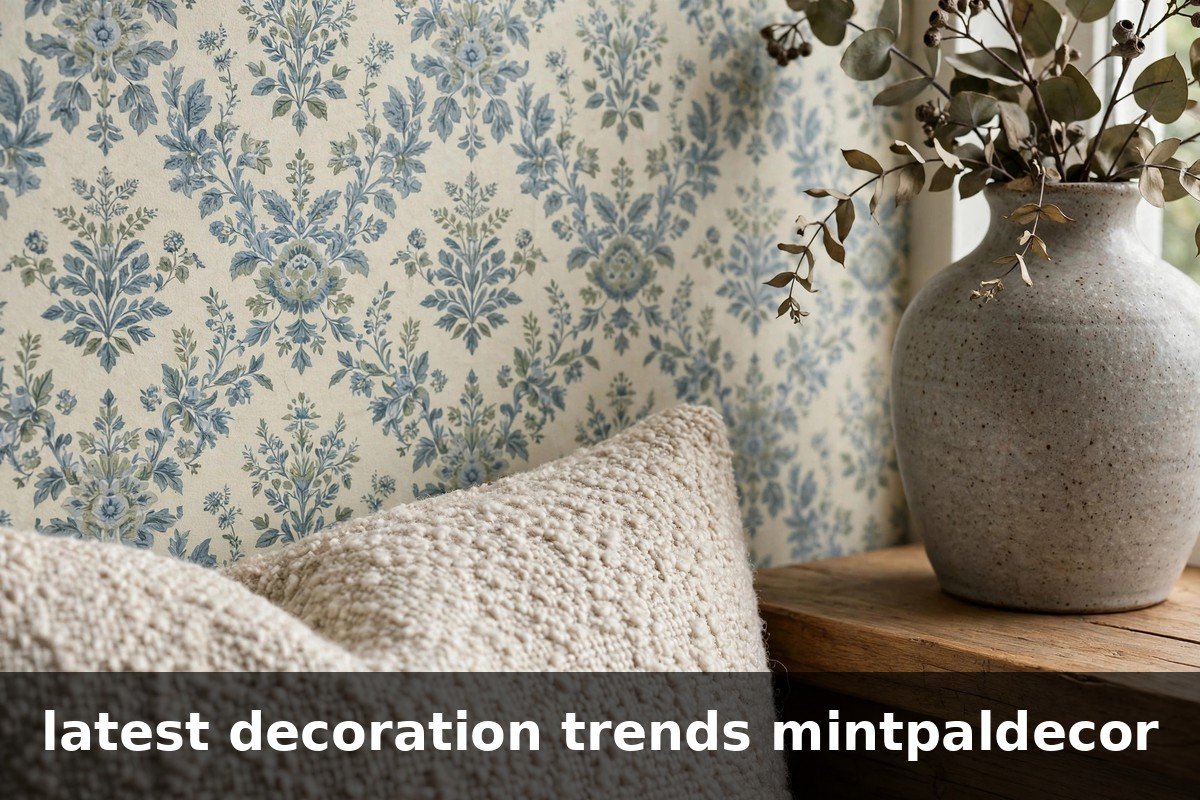
Bold pattern is the fourth trend, and the most visible one: large-scale floral and botanical wallpaper, strong stripes, and rich colour on a single feature wall. The important word is single — the trend is not to paper every wall, but to give one wall the pattern and keep the rest quiet. A patterned wall behind a bed gives the room a focus. The same pattern on all four walls would overwhelm it.
Finally, second-hand and vintage pieces are firmly part of current decoration: a solid older piece of furniture, a vintage lamp, a framed print found at a market add character that new furniture often lacks. Mixing one older piece into a modern room is the most reliable way to make it look personal.
Which trends are worth trying, and which should you treat with caution?
The trends most worth trying are the ones that are cheap to reverse and that suit the home you already have. Layered light is the safest of all: a ceiling light, a lamp beside the main seat, and one low lamp, with warm white bulbs around 2700K as a practical estimate. Good light flatters every other trend, and it costs little. Textured textiles are nearly as safe: a wool throw, linen cushion covers, a woven rug. Indoor plants are a third safe trend, as long as you choose plants that suit your light.
Warm neutrals and natural materials are worth trying, with one caution: test the colour in your own room first. A warm beige that looks soft in a bright showroom can look yellow in a north-facing room with little daylight. Paint a large tester patch, at least a metre square, and live with it for three days. The same applies to wood tones: hold the sample against your floor and furniture in daylight, not under shop lights.
Trends to treat with caution are the ones that are expensive to undo or that only suit one kind of home. Whole-room bold colour is the first: a deep green or dark blue on every wall can look wonderful in a large room with tall windows, and oppressive in a small room with one small window — if you love the colour, try it on one wall first. All-black kitchens and bathrooms are the second: they photograph beautifully and show every water mark in daily use. And matching everything in one material — all boucle, all rattan, all chrome — should be treated with caution, because a room made of one material looks like a display.
Part of enjoying trends is remembering why the work itself is rewarding. If you are wondering what draws people to decorating in the first place, why interior design is interesting mintpaldecor looks at what makes this kind of work satisfying for homeowners who enjoy improving their own space. Trends come and go, but the pleasure of getting a room right is what keeps people decorating long after a particular trend has faded.
| Trend | Where it works best | Try it cheaply |
|---|---|---|
| Warm neutrals | Any room, especially north-facing rooms that feel cold | One tester pot, one wall |
| Natural wood and stone | Kitchens, living rooms, hallways | One wooden tray or linen cushion cover |
| Curved shapes | Small rooms, bedrooms, reading corners | One round mirror or curved lamp |
| Bold pattern, one wall | Bedrooms, living rooms, dining rooms | One feature wall, not the whole room |
| Layered light | Every room | One lamp beside the main seat |
| Vintage and second-hand | Any room that feels too new | One older lamp or framed print |
| Indoor plants | Bright rooms with a windowsill | One plant that suits your light |
What is fading, and what should you avoid?
Cool grey is the clearest fading trend. For years, grey walls, grey sofas and grey floors were the default, and many homes still have them. The direction now is warmer, and a room that is entirely grey can feel cold and flat, especially in the evening. That does not mean you must repaint every grey wall tomorrow — grey works when it is warmed up with wooden furniture, warm-toned textiles, a cream rug, or brass details. Grey on its own is not the issue. The issue is grey with nothing warm beside it.
All-white rooms are fading in the same way. A white room with no texture and no colour looks clean in a photograph and empty in real life. If your room is all white, add texture before you add colour: a woven rug, linen curtains, a wooden frame, a plant.
Open shelving in kitchens is fading too, for a practical reason: open shelves need constant tidying, and they collect grease and dust in a working kitchen.
What should you avoid entirely? Trends that require structural change for a short-lived look: removing a wall because open-plan is fashionable, or fitting a trend-driven kitchen that will date in five years. And avoid buying a whole room of one trend at once — a room bought in a single shopping trip looks dated the moment the season changes.
How do you try a trend cheaply without redoing a whole room?
The cheapest way to try a trend is to change the smallest thing that carries it. For colour, that means one wall, or even one piece of furniture. For pattern, it means one wall of wallpaper, or one patterned cushion cover. For a material, it means one object: a wooden tray, a stone vase, a rattan basket. One object is enough to test whether the trend suits the room.
Wallpaper is the best example. Bold, patterned wallpaper is a leading trend, and papering a whole room is expensive and hard to reverse. Papering one feature wall — the wall behind the bed, or the wall you face when you enter — gives you the full effect for a fraction of the cost and effort. Measure the wall first, then use a Wallpaper Calculator to work out how many rolls you need, so you order the right amount and buy from one batch for a matching print. A feature wall of about 3 by 2.5 metres usually needs two to three rolls as a practical estimate, depending on the pattern repeat.
Textiles are the second-cheapest test. Cushion covers, a throw, a table runner, a curtain panel: all of these can be changed in an afternoon, and all of them can move with you if you rent. Buy the textile version of a trend before you buy the furniture version — if you love the colour on a cushion, you will love it on a wall.
Paint is the third cheap test, with one condition: test it properly. A tester pot costs very little, but a small swatch on a white card tells you almost nothing. Paint a patch at least a metre square directly on the wall, and look at it in daylight, in the evening, and on a cloudy day. Live with the patch for three days — if you still like it, buy the full tins.
How do you mix a trend with a home you already have?
A trend should join the home you have, not replace it. The simplest way to mix is the one-in, one-out rule: when a trend piece comes in, one existing piece goes out, at least for a while. A new curved mirror replaces the old rectangular one. The room keeps its structure, and the trend arrives as a guest, not as an invasion.
Colour is the easiest bridge. If the trend is a warm terracotta, you do not need terracotta walls: a terracotta cushion, a plant pot, and a throw over the sofa arm are enough to bring the colour in, and the rest of the room stays as it is. Three small touches of one colour read as intentional. One large touch reads as an accident.
Style mixing follows the same logic. A vintage lamp works in a modern room because it is one old thing among new things, and a modern print works in a traditional room for the same reason. The rule is proportion: most of the room stays in its existing style, and the trend arrives in one or two pieces.
Finally, respect the bones of your home. A trend designed for a large, bright house with tall ceilings will not behave the same way in a small flat with low ceilings and one window. Dark colours need light, large-scale pattern needs wall space, and curved furniture needs floor space. Choose the trends that suit the room you actually have.
What can trends not do for you?
No trend can rescue a room that fails at the basics. A room with bad light, awkward layout or damp will still have all three after you follow the latest trend. Trends decorate the surface; they do not repair the structure. Sort out the structure, the mould or the leaking roof first, and only decorate once the cause is repaired and the wall has dried out completely.
Trends also cannot give you taste. Taste develops slowly, through looking, measuring, testing and finishing rooms. Following every trend as it appears is the opposite of taste — it is letting other people decide what your home should look like. The homes that age best are the ones where the owner chose slowly and let trends arrive one piece at a time.
And trends cannot make a home personal. A room bought entirely from this season’s collections looks like a showroom, however fashionable it is. The rooms people remember have something personal in them: a piece of furniture with a history, a colour chosen because the owner loves it, not because it is trending. Treat trends as a source of ideas, not as a list of things to buy.
| Trend | Risk level | What to do |
|---|---|---|
| Layered light | Low — cheap, reversible, suits every room | Add one lamp beside the main seat |
| Textured textiles | Low — changeable in an afternoon | One wool throw or linen cushion cover |
| Warm neutrals | Low — test a large patch first | Tester pot, three days, then decide |
| Natural materials | Low — start with one object | One wooden tray or woven basket |
| Curved shapes | Medium — check the floor space first | One round mirror before any furniture |
| Bold pattern, one wall | Medium — measure and calculate rolls first | One feature wall, matching batch |
| Whole-room bold colour | High — expensive to reverse, needs light | Try one wall first, live with it |
| All-black kitchen or bathroom | High — shows every mark in daily use | Test with one black object first |
Frequently asked questions
How often do decoration trends change?
As a practical estimate, the leading trends change noticeably every two to three years, while small details can come and go within a single year. The slow trends, such as natural materials and layered light, last much longer.
Should I follow every new trend?
No. Follow the trends that suit your home, your light and your budget, and ignore the rest.
What trend works best in a small room?
Curved shapes and layered light work best, because a round table is easier to walk around and good light makes a small room feel larger. Warm neutrals help too, while large-scale pattern and very dark colours need more space.
Are bold colours still trending?
Yes — as an accent, in small touches, rather than across a whole room. One bold wall or bold colour in three small places is the current direction. Whole rooms in one bold colour are fading, because they are expensive to reverse.
How can I tell whether a trend fits my home?
Try it small first — one object, one wall, one textile — and live with it for two weeks. If you keep noticing it with pleasure, it suits you.
Conclusion
latest decoration trends mintpaldecor is a digest, not a set of rules: warm neutrals, natural materials, curved shapes, bold pattern on one wall, layered light and second-hand finds are leading right now, and the smart way to use them is small, cheap and reversible. Take one trend at a time, try it in your own light, and keep only what you still enjoy after two weeks. For more advice you can measure, visit Mintpaldecor.


2 comments