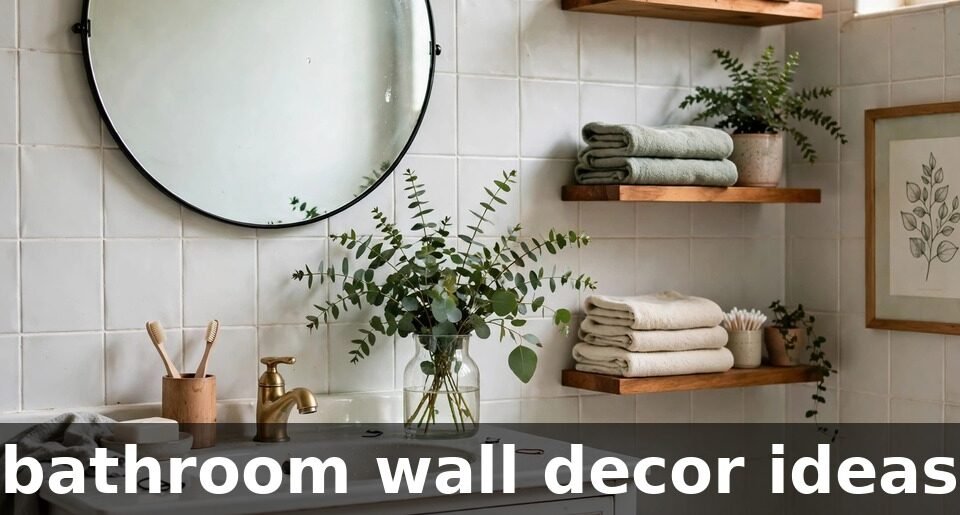
Good bathroom wall decor ideas start with what survives steam and splashes, then add mirrors, shelves and art that make a small bathroom feel brighter. The best bathroom wall decor ideas keep the walls useful as well as pretty, so every hook, shelf and picture earns its place.
Key Takeaways
- Choose wall decor that survives steam and splashes first — paper and untreated wood will not last.
- A mirror across from the window or next to a light makes a small bathroom feel twice as bright.
- Floating shelves and ledges keep bottles and plants off the floor and within reach.
- Hang art above the toilet or beside the vanity, where it stays clear of direct spray.
- A tile feature wall suits the wettest wall; hooks and rails turn storage into decoration.
What survives on a bathroom wall — and what does not?
A bathroom wall lives in steam. Every hot shower fills the room with damp air, and the walls take the worst of it, so the first question for any bathroom wall decor ideas plan is not what looks good but what lasts. Glass, glazed tile, metal and sealed wood survive; bare paper, untreated wood and fabric do not. A framed print behind glass lasts for years above a toilet, while the same print in an open frame curls and spots within months. The advice in interior decoration advice mintpaldecor fits here too — choose the wall by what it has to endure.
Paint is the simplest wall finish, but it has to be the right paint. A bathroom needs a washable paint, not a matt one, because splashes wipe off a washable surface and leave a mark on a matt one. Mould grows where the air stays damp, so a wall that never dries out is a wall that will spot — an extractor fan or an open window after a shower does more for the walls than any decoration can.
Wallpaper can work in a bathroom, but only in the right place and the right kind. A peel-and-stick paper on a dry wall away from the shower adds pattern without a big commitment, and it can be changed when tastes change. Paper beside the bath or behind the basin will peel at the edges, because the steam gets behind it. If the room is small and steamy, keep the paper to one wall and let tile or paint carry the wettest areas.
| Wall decor | How it copes with steam | Where it works best |
|---|---|---|
| Mirror | Untouched by steam if wiped now and then | Above the vanity, opposite the window |
| Framed art behind glass | Good, if the frame seals well | Above the toilet, on a dry wall |
| Floating shelves | Good in sealed wood or metal | Beside the mirror, above the basin |
| Peel-and-stick wallpaper | Fair on a dry wall, poor near spray | One accent wall, away from the shower |
| Tile feature wall | Excellent everywhere | Behind the basin, inside the shower |
| Hooks and rails | Excellent in metal or sealed wood | On the door, beside the shower |
How does a mirror change a small bathroom?
A mirror is the hardest-working thing on a bathroom wall. It gives the room a place to check a face and brush teeth, and it throws the light around so a small, windowless bathroom feels twice as bright. A mirror above the vanity is the obvious place, but a mirror on the wall opposite the window does more for the light — it catches the daylight and sends it back across the room, so the far wall never sits in shadow. A tall mirror on a narrow wall stretches the room upward, while a wide mirror above a long vanity stretches it sideways.
Your mirror choice gives the wall its character. A round mirror softens a room full of straight lines and sharp corners; a rectangular mirror suits a long vanity and a straight shelf; an arched mirror gives a plain wall a shape of its own. A frameless mirror disappears into the wall and suits a room where the tile already carries the pattern; a thin metal frame in black or brass gives the wall a line to look at. A mirror with a small shelf built into its base holds the toothbrushes and the soap, so the basin stays clear.
Steam is the mirror’s only enemy: a quick wipe after a shower keeps it clear, and a mirror away from the shower fogs less than one beside it. Hang it at eye level — too high and it reflects the ceiling, too low and it reflects the basin.
What goes on shelves and ledges in a bathroom?
Shelves and ledges turn a bare bathroom wall into working storage without taking a centimetre of floor. A floating shelf beside the mirror holds the bottles used every day — the cleanser, the moisturiser, the toothpaste — at the height they are used. A narrow ledge above the basin holds a small plant and a candle, and a shelf above the toilet holds spare towels and a basket. The rule is simple: what is used daily goes within reach, and what is used weekly goes higher.
What the shelf is made of matters as much as where it goes. Sealed wood, glass and metal survive the steam; bare wood swells and spots, and a shelf that sags under a row of bottles is worse than no shelf at all. A glass shelf shows the wall behind it and keeps the room feeling light, while a wooden shelf adds warmth to a room full of tile. Keep the shelf shallow — about 15 centimetres deep is enough for most bottles — so it never juts into the room and catches an elbow.
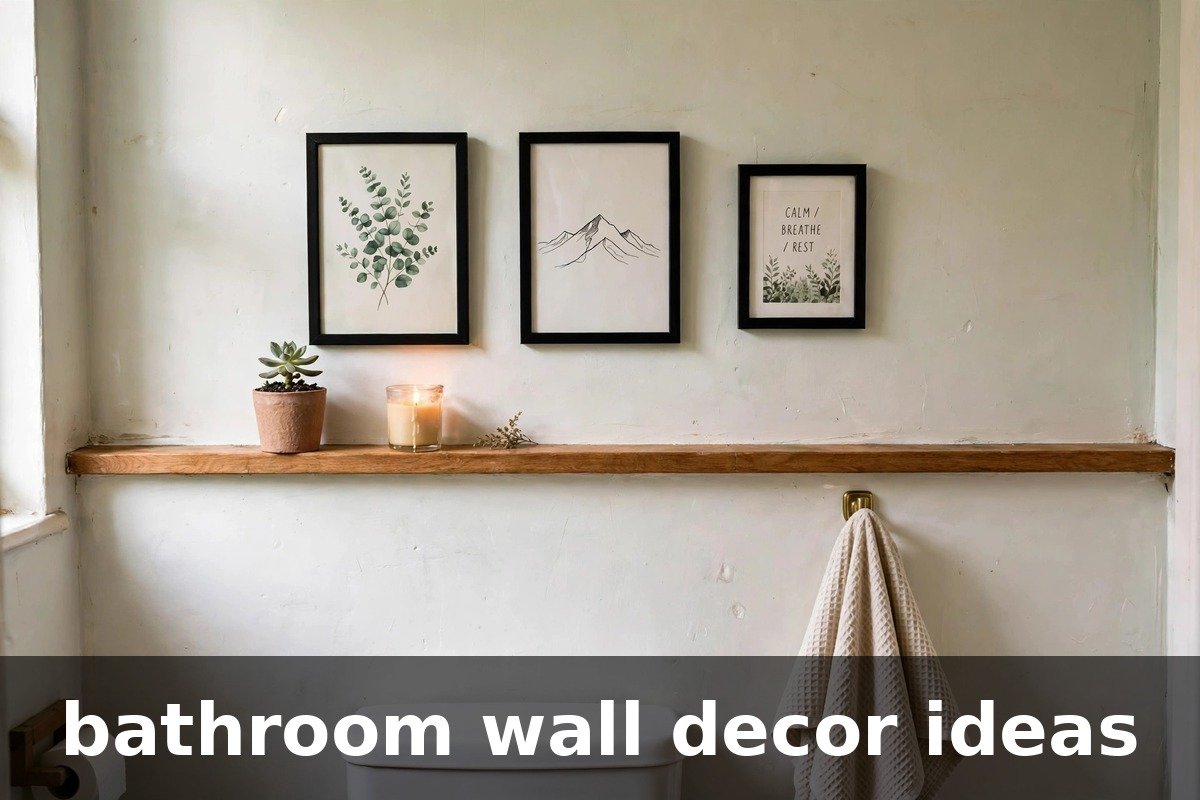
A ledge is a shelf with a lip, and it suits the things that lean: a small picture, a tray of perfumes, a plant in a pot. A picture ledge above the toilet lets the art change with the seasons without new holes in the wall. Keep the ledge short — a long ledge collects clutter, while a short one stays tidy. One or two objects on a ledge look chosen; five look stored.
How do you hang art and build a gallery wall in a bathroom?
Art in a bathroom works when it is hung where the water cannot reach it. The wall above the toilet is the classic spot: it is dry, it is at eye level when standing, and it is the first wall a visitor sees. The wall beside the vanity works too, as long as the frame stays clear of the basin splash. Never hang an unprotected print inside the shower or directly above the bath — the steam will reach it every day, and no frame seals perfectly forever.
Keep a bathroom gallery wall small, not large. Two or three frames in a row suit a narrow wall; four small frames in a square suit the wall above the toilet. Mix a print with a small mirror or a woven piece, so the wall has texture as well as colour. Keep the frames in one finish — black, brass or pale wood — so the group reads as one picture rather than a jumble. Hang the frames at eye level, with the centre of the group about 150 centimetres from the floor, and leave a gap of about 5 centimetres between frames so each frame has room to breathe.
A strip of peel-and-stick wallpaper behind the gallery turns a plain wall into a backdrop, and it can be changed without repainting the room. A Wallpaper Calculator can work out how much paper a single wall needs before ordering, so the strip matches the gallery instead of arriving short. The paper should sit on a dry wall, away from the shower, and the frames should hang on top of it with picture hooks rather than nails through the paper.
When does a tile feature wall make sense?
A tile feature wall is the most durable decoration a bathroom wall can have, and it suits the wall that gets wettest. Behind the basin, a band of tile protects the paint from splashes and gives the vanity a finished edge. Inside the shower, tile is the wall itself, and a change of colour or pattern there turns a plain shower into the room’s centrepiece. A single wall of patterned tile behind a freestanding bath makes the bath look placed, not parked.
The tile does not have to cover the whole wall. A band of tile to shoulder height behind the basin, a strip of mosaic above the bath, or a panel of large tiles behind the toilet all give the room a feature without the cost of tiling every wall. Large tiles make a small bathroom feel larger, because there are fewer grout lines to break the surface; small mosaic tiles suit a curved wall or a niche, where large tiles would need cutting. The bathroom wall trends in latest decoration trends mintpaldecor show how quickly tile colours move on, so choose a tile that suits the room for years and let the towels and the art carry the fashion.
Grout is the part of a tile wall that ages first. A dark grout hides the marks of daily use, while a pale grout shows them; a sealed grout resists the damp that feeds mould. Wipe the grout after a steamy shower and it stays clean for years. A tile wall is a long-term choice, and it should be laid by someone who does it every day — a badly laid tile shows within a season.
| Where to hang it | What works | What to avoid |
|---|---|---|
| Above the vanity | A mirror, a small shelf, a light | A large frame that crowds the mirror |
| Above the toilet | A gallery wall, a ledge, a small plant | Anything heavy that could fall |
| Beside the mirror | A narrow shelf, a rail, a small print | A deep shelf that juts into the room |
| Opposite the window | A large mirror, a pale print | A dark frame that swallows the light |
| On the door | Hooks, a rail, a small mirror | Anything that stops the door closing |
What stays hard about bathroom walls, even with good decor?
Some things about bathroom walls do not change with better decoration, and it is worth knowing them before spending money. First, the damp itself. A bathroom that steams up every time the shower runs will stay damp, and decoration cannot dry a room: the air has to move, through a fan or an open window, or the walls will spot whatever hangs on them. A mirror will fog, a frame will curl, and a shelf will spot, until the air is dealt with. Moving the air matters more than any frame does.
Next, the size of the wall. A small bathroom has only so much wall, and a wall that holds a mirror, a shelf and a light cannot also hold a gallery, a cabinet and a towel rail. Trying to fit them all in leaves a wall where nothing has room to be seen. The honest answer is to choose what the wall is for — the mirror and the light, usually — and let the rest of the room carry the other jobs.
And last, the plumbing behind the wall. A wall that carries pipes cannot take a deep shelf or a heavy cabinet without hitting them, and a wall that hides a soil pipe cannot be drilled at will. A stud finder and a careful look at where the pipes run will save a flooded wall, and a hook that goes into a pipe is a repair, not a decoration. Hang light things where the pipes are unknown, and leave the heavy fixings to someone who knows what sits behind the plaster.
None of this means a bathroom wall is a lost cause. It means the wall works best when it is planned for what it is — a wet, small, busy surface — and the decoration is chosen to suit those facts. A wall with a mirror that catches the light, a shelf for the daily bottles, and a picture that survives the steam feels finished in a way a crowded wall never does.
Frequently Asked Questions
Can I hang pictures in a bathroom?
Yes, if they sit behind glass and stay clear of direct spray. Hang them above the toilet or beside the vanity, where the steam is lightest, and choose frames that seal well. An unprotected print inside the shower or above the bath will curl and spot within months.
What is the best mirror size for a small bathroom?
A mirror about as wide as the vanity suits most small bathrooms, hung with its centre about 150 centimetres from the floor.
Does wallpaper work in a bathroom?
Peel-and-stick wallpaper works on a dry wall away from the shower, and it can be changed without repainting. It will peel at the edges beside the bath or behind the basin, so keep it to one accent wall and let tile or washable paint carry the wettest areas.
How do I stop bathroom walls going mouldy?
Move the air: run the extractor fan during and after a shower, and open a window when the weather allows. Wipe the walls and grout after a steamy shower, and use washable paint so splashes wipe off instead of soaking in.
What can I put on the wall above the toilet?
A small gallery wall, a picture ledge or a shelf with a plant suits the wall above the toilet, because it stays dry and sits at eye level. Keep the pieces light — a heavy frame above a toilet is a risk if it ever falls.
Conclusion
bathroom wall decor ideas work when the wall is planned around the steam first and the decoration second: a mirror that catches the light, shelves that hold the daily bottles, art that sits behind glass on a dry wall, and a tile feature where the water lands. Start with the wettest wall, choose materials that survive it, and add the rest in stages. For calculators, guides and more ideas, visit Mintpaldecor.